

NEW TO MX CONNECTIVITY?See the Connectivity Overview to learn about our Connectivity products and integration options.
Integrate using the Connect Widget
Use the Connect Widget and Platform API to let end users connect to their accounts.
Integrate using the Platform API
Use the Platform API to power a non-MX UI connection experience.
Aggregation
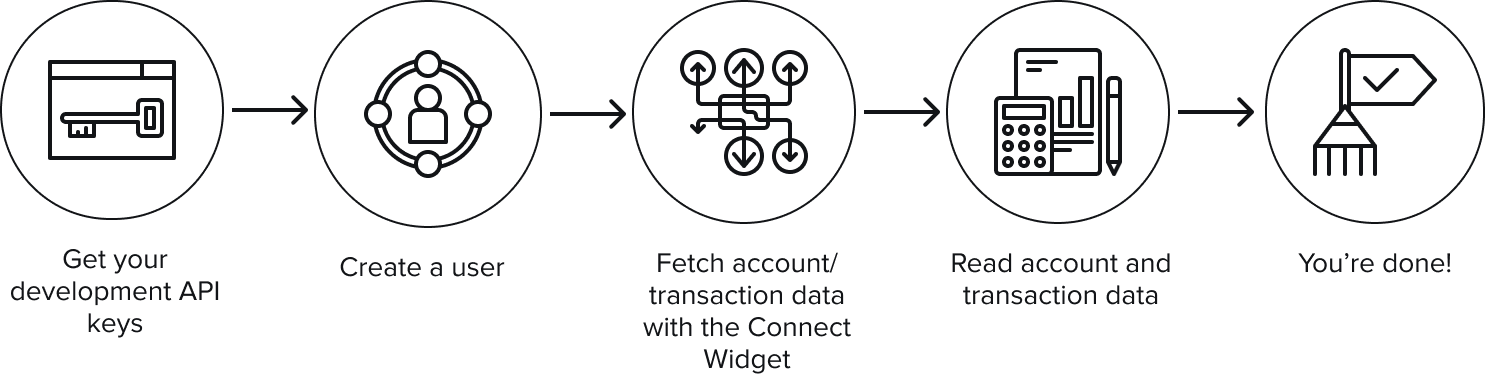
Aggregation is an important feature of the Platform API. Aggregating data enables people to see when, where, and how much they are spending. This helps you build solutions that can improve the financial lives of your institution’s customers. The best way to aggregate data is with the Connect Widget, MX’s ready-made UI that can be embedded in your application to aggregate users’ account data by prompting end users to connect to their financial institutions using their credentials. This is the preferred method of aggregation.Background Aggregation
MX automatically aggregates eachmember approximately every 24 hours. This process is called background aggregation. It ensures that end users’ data is always up to date. This is beneficial because, if a background aggregation is successful (for example, the successfully_aggregated_at field indicates a time within the last 24 hours), you can choose to skip foreground aggregation and jump right to reading account and transaction data, which can help you load things faster in your product.
This background aggregation can be disabled by default for all members. Please reach out to MX to have this setting configured.
Background aggregation can be disabled or enabled for individual members by setting the background_aggregation_is_disabled field when creating or updating a member (or the disable_background_agg configuration option when using the Connect Widget).
Background aggregation is also disabled for members created when using the Connect Widget in verification mode. You can override this behavior by setting the disable_background_agg widget option to false. Note that this only affects newly created members.
There are a few other general rules related to background aggregation:
- The data source must allow background aggregation. Most sources do, but there are cases in which the data source does not.
- The member must not have been aggregated in the last 20 hours.
- The member must be in a
CONNECTED,UPDATED, orCREATEDstate.
Foreground Aggregation
If an end user is present, you can choose to manually run a foreground aggregation. End users must be present during foreground aggregations because they may run into MFA, credential update requests, terms and conditions agreements, or other situations requiring end-user input. Just keep in mind that you cannot run a new aggregation within three hours of a successful aggregation, whether foreground or background. Thus, attention must be paid to theaggregated_at and successfully_aggregated_at member fields while you’re developing your product with the Platform API.
INFOBoth foreground and background aggregation may be prevented by disabling a
user. A user must be re-enabled before any aggregation can be attempted. We may suspend background aggregation on a particular member in some circumstances, such as when several consecutive aggregation attempts fail. However, you can always attempt a foreground aggregation on a suspended member.Quick Links
API Reference
Learn about the full features of the Platform API.
Connect Widget
Learn about the Connect Widget.
Demo App
View the demo app on GitHub.
Account Sample Data
This sample response shows the data you can expect to get for financial accounts.Transaction Sample Data
This sample response shows the data you can expect to get for transactions.Related Products
Extended Transaction History
Gather end users’ tax statements or credit card rewards, such as miles or points, by connecting to their accounts with our Account Aggregation product. For additional transaction history, continue with our Extended Transaction History product.
Statements
With our Statements product, connect to an end user’s financial account to retrieve PDF financial statements to gather more information for decisioning.