
Types of Insights
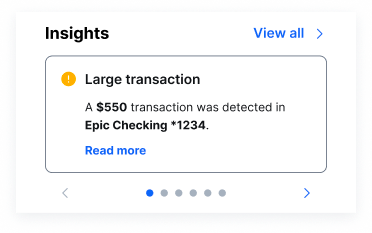
Financial Insights cover a wide range of financial scenarios, including:- Borrow: Information about credit and debt management
- Plan: Alerts about key information, such as tax deadlines and bank holidays
- Save: Notifications about savings accounts and behavior
- Spend: Recommendations on current spending, including low balance alerts and fee detection
Financial Insights Quick Links
Insights Library
Learn more about each insight.
Developer Guides
Are you a developer? Here’s all our guides in one place.
Accessibility FAQs
Accessibility FAQs
With the mission of empowering the world to be financially strong, MX is focused on providing a robust experience for clients and end users of our products and guided by the WCAG 2.1 A and AA recommendations.For more info, see Accessibility at MX PDF.
WCAG Status
MX’s web-based application that hosts our Personal Finance Management and Financial Insights products is made up of smaller parts called widgets, all of which align with WCAG 2.0 recommendations when accessed through the most recent versions of Chrome, Edge, Firefox, and Safari browsers. All enhancements and new features are designed to have strong conformance to WCAG 2.1 A & AA guidelines.MX no longer supports IE11 as Microsoft has stopped supporting their browser on August 17th, 2021.While the WCAG guidelines are focused on web accessibility rather than native applications, MX products have been upgraded to have strong conformance with the WCAG 2.0 A and AA guidelines when used on iOS and Android devices. Continual enhancements prioritize WCAG 2.1 alignment based on feedback received through user testing.MX leverages LevelAccess solutions for education, evaluation and testing.Current Work
MX has adopted a phased approach to development, guided by WCAG’s four key foundations: perceivability, operability, understandability, and robustness through which legacy systems are progressively improved as we endeavor to meet the needs of end users. New features are designed for accessibility improvements from conception through completion.Future Work
Evaluation and accreditation
Our goal is to improve both our knowledge and users’ experiences by working with experts in the field. We will accomplish this through internal education and external engagement with a11y community. We are also evaluating automation software that can improve the speed of solutions development and verification for all users.Several MX clients have provided 3rd party evaluations of our services. We will continue to respond to these reports as a means to improving our solutions. We continue to assess the merit of formal accreditation through a third party in the future.User testing
Given the unique nature of some features, we recognize the value and insight that user testing provides. In our pursuit of achieving the best overall digital experience, we have begun to incorporate user testing in development and are continuing to refine and expand our testing efforts.Background on Guidelines
The Americans with Disabilities Act (ADA) does not include any language specific to websites or web-development. However, Title II of the ADA mandates that all “places of public accommodation” (all businesses open to the public) are required to remove “access barriers” that would hinder a disabled person’s access to that business’s goods or services.The World Wide Web Consortium’s (W3C) Web Content Accessibility Guidelines (WCAG 2.0 AA) is seen as the world standard for defining what an “accessible” website is. While these are only guidelines, they have been adopted as the standard by court precedence, and any future regulation will likely point to this standard.In June 2018, W3C adopted the WCAG 2.1 guidelines (which are backward compatible with WCAG 2.0 recommendations) with the additional goal of improving accessibility for users with disabilities on mobile devices.Additional Info
Here are some other useful links:Security & Privacy FAQs
Security & Privacy FAQs
Your users’ data is safe inside MX’s Personal Finance Management (PFM) tools. Because PFM is embedded inside online banking, access is protected by banking-level encryption, just like an online banking account. In addition, PFM and the Mobile Banking application use their own additional layer of security when transmitting data.When users add all of their accounts to PFM, they can monitor them in one place, and are much more likely to catch potential fraudulent transactions.
Does MX Sell User Info to 3rd Parties?
No. Financial information is never sold to third parties.When a User Adds an Account Who Can See It?
No one at a user’s financial institution has the ability to access user’s information in PFM. The MX Support Team (who powers the tools) may view an account, for the purposes of providing support. No one has access to a user’s account credentials.User data may be aggregated for trends analysis and target marketing, but no one at a financial institution can look for a specific individual’s account, or at any individual’s complete account information.Some financial institutions may allow account impersonation for the purpose of providing support.Privacy Policy
We’re committed to keeping your user’s information secure, and as such we implement privacy standards to guard against identity theft and unauthorized access to user’s information. We also regularly monitor and reevaluate our privacy and security policies and adapt them as necessary to deal with new conditions.We use industry-accepted standards, protocols and precautions to protect personally identifiable information from loss, misuse, unauthorized access or disclosure, alteration or destruction. We maintain physical, electronic and procedural safeguards for personally identifiable information, including using firewall barriers, encryption techniques, authentication procedures, SSL (secure socket layer) encryption, and physical safeguards. In addition, we do not sell any personally identifiable information.We will post changes to the policy in the PFM tool so that users will always know what information we gather, how we might use that information, and when we will disclose that information to third parties, if at all. We may also inform users of any changes to this policy by a prominent notice within the services or by email. In addition, and at our discretion, in the event of an update or material change, users may be required to agree to the new privacy policy as a condition precedent to your continued use of the services.Create Custom Insights
Reach out to your MX representative to create, configure, and deploy your own custom Insights to support your unique business goals. You can define language and calls to action (CTAs), and view performance metrics for the Insights you create. To create a custom insight, you will need:- The text of your insight (title, description). We recommend a title length of less than 25 characters and a description length of less than 150 characters.
-
The trigger conditions (choose one):
- Schedule-based: The insight appears at specific intervals. Specify the number of cooldown days where applicable.
- Event-based: The insight appears when specific account or transaction events occur. Criteria can include transaction name, type, amount, merchant, category, and many others.
- Example: “If a transaction amount is greater than $100 from Epic Bank”
-
The text of any CTAs
- CTA button (this appears at the bottom of an insight)
- CTA link (this appears as part of the description copy)
- The string for the postMessage event that triggers when the user clicks the CTA
You will need to be prepared to handle CTAs through postMessage events.
Insights Widgets
There are three widgets that display insights.- Insights Widget
- Mini Insights Widget
- Micro Insights Widget
The Insights Widget is a vertical feed of insights.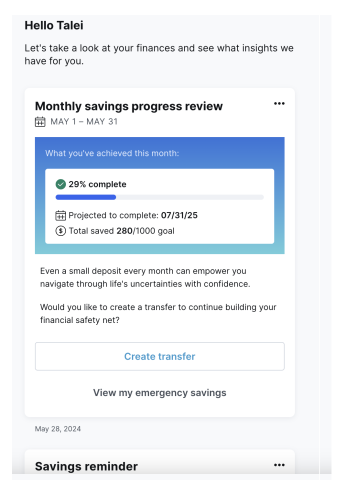

Insight Generation
Insights generate when triggered by either:- a system event (such as a new transaction or account update)
- a scheduled trigger
Insight Schedules
Some, but not all, insights begin triggering based on one of the following schedules.Insight Notifications
Users can receive notifications from over 20 insights through any of our notification channels (in-app, SMS, push notifications, or email). Reach out to your MX representative to turn them on.Transaction Inline Insights
Some Insights can display alongside the transaction they were generated for. These appear in the Transactions section of the Mobile Banking Dashboard, the Transactions Widget, and Money Dashboard Widget.Static vs. Dynamic Insights
Every insight uses static or dynamic data. Static insights use the data that’s available when the insight is created. That data doesn’t change and the insight remains the same in the feed. Dynamic insights generate the same way as static insights, but can be refreshed with the latest data.Insight Thresholds
Some insights have thresholds that cause the insight to trigger. For example, by default, theDeposit529 insight is triggered when a deposit of $10 or more is made.
Here’s a list of all insights with configurable thresholds.
Insight Versioning
When we make a change to an insight that requires backend changes beyond what the insight was originally intended to do, we create a new version of the insight. An example of this is the WeekendSpendingSummary and WeekendSpendingSummaryV2 insight templates. We suggest you use the latest version for each insight.Supported Browsers
MX supports HTML5-compliant browsers that support TLSv1.2 or higher (required since March 20, 2017).Supported Desktop Browsers
MX tests its web applications on the current version and previous version of the following browsers:BLOCKED BROWSERSMX doesn’t support Internet Explorer and won’t address related issues.MX may actively block some browsers from displaying our products when the results would provide a poor user experience.Browsers in Compatibility or Quirks mode may not function and can be blocked if performance is degraded.
Supported Mobile Browsers
MX tests its web applications on the current version and previous version of iOS and Android, using the following browsers:UIWebView is no longer supported. Apple recommends using WKWebView.